Home self-monitoring
Guided home use and result tracking for selected assays validated and authorized for self-testing.
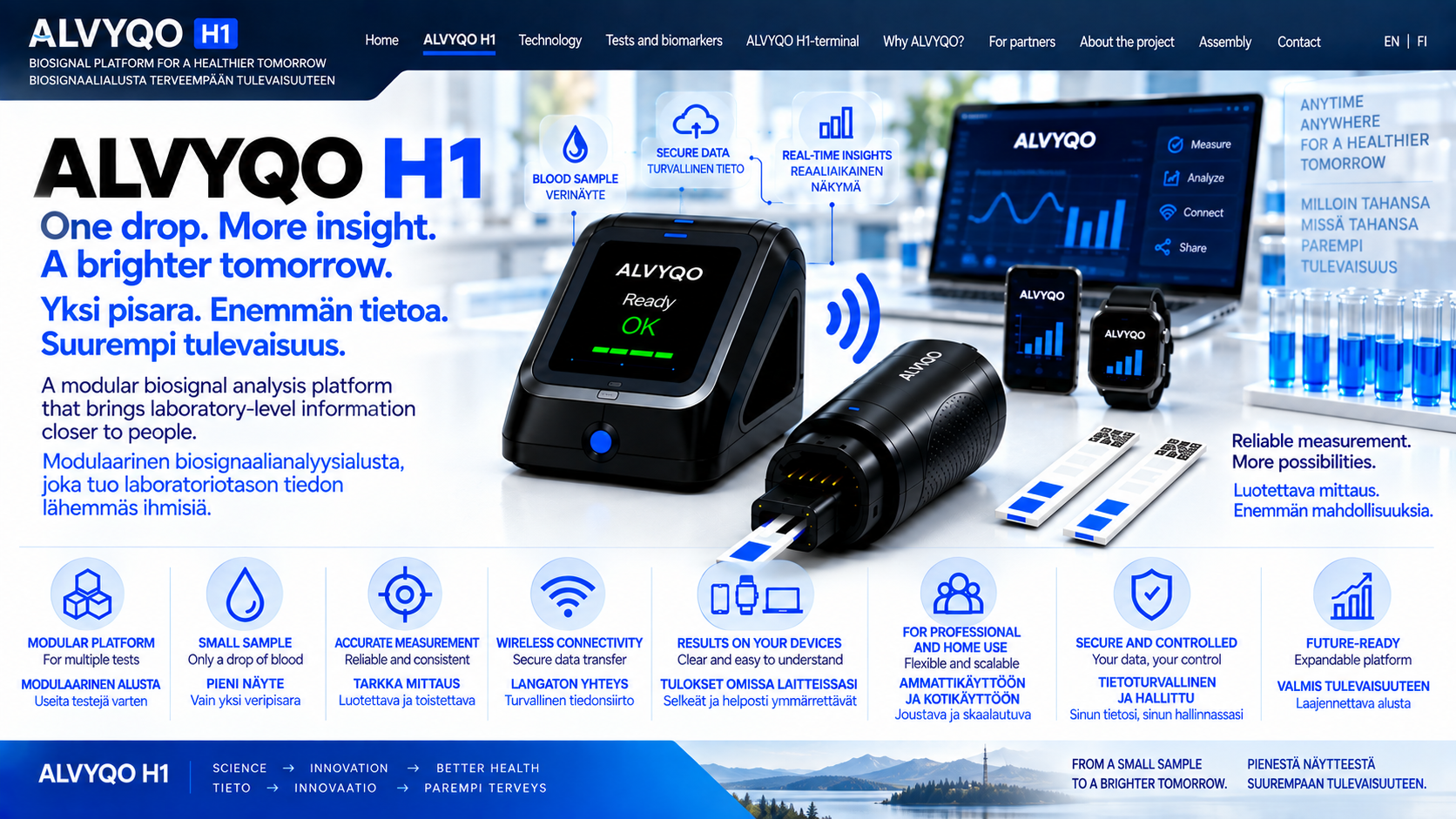
Development-concept visualization — future use and workflow directions are not current authorized intended uses and are not validated performance/comparative claims.
Likes and comments for images.
…
Likes and comments for videos.
…
The ALVYQO H1 development goal is not a meter tied to a single test, but a common reusable Reader platform that can work with different disposable test units. The goal is to combine simple sample handling, HOME and PROFESSIONAL operating modes, and secure digital result transfer within one system architecture.
Conditional future scenario: with an approved integration and clinical workflow, a result generated at the point of care could potentially reach the receiving care unit before the patient arrives. This is a development target, not a current clinical service.
The point-of-care market includes specialized handheld meters, professional multi-test analyzers, strip/chip systems, and cartridge or cuvette workflows. ALVYQO is not positioned against a named manufacturer or product; the development goal is to combine selected benefits of these approaches within one portable platform.
| Area | Current market solutions – generally | ALVYQO H1 – development target |
|---|---|---|
| Device architecture | Often optimized for one test area or technology family; some platforms support multiple tests. | One common Reader plus interchangeable test units for multiple assay families. |
| Sample handling | Depending on the system: direct strip/chip sampling or multi-step capillary, cartridge, cuvette or reagent workflows. | Where the assay allows it: direct blood drop to the disposable test unit with minimal manual transfer. |
| Home use | Available in some specialized systems; many professional POC platforms are not primarily designed for self-testing. | HOME mode as part of the same platform logic after the required self-test validation. |
| Professional use | Widely available, often with institutional workflow and connectivity. | PRO mode with patient/operator identification, QC, lot and audit information through approved integrations. |
| Portability | Ranges from handheld meters to larger benchtop analyzers. | An easily portable Reader designed so that field and mobile robustness can be developed and verified. |
| PC / mobile connectivity | Many modern systems already provide some form of connectivity. | PC, mobile and tablet connectivity within one digital environment and an authorization-based data flow. |
| Result transfer | System- and institution-dependent. | Secure, permission- and consent-based transfer with future healthcare-system integration. |
| Test recognition / QC | System-dependent; many devices already use advanced automated controls. | Cartridge ID + lot + expiry + Reader capability + sample adequacy + signal quality + calibration/QC chain, with a safe NO RESULT state when requirements are not met. |
| Expansion | A new test may require another meter, module, or a separate test family within the same technology platform. | Add compatible test units to the same Reader ecosystem where technical and regulatory conditions permit. |
The following are not current authorized indications. They are environments where a future validated portable blood-based point-of-care platform could create value.
Guided home use and result tracking for selected assays validated and authorized for self-testing.
Measurement at the patient’s home with the option of secure data sharing with the care team.
Selected follow-up or routine tests could be brought closer to older patients where clinically appropriate.
Rapid local results may support patient routing, decisions on further testing and timing of the next care step.
Selected tests could potentially be completed during the visit when the assay and intended use allow it.
In time-critical situations, local blood testing may support earlier triage and decision-making; with approved integration, the result could potentially be transmitted to the receiving facility.
Rapid near-patient results may support emergency workflows and prioritization of further laboratory or imaging investigations.
Local monitoring of selected parameters on wards, observation units or intensive-care environments.
Time-series results and trends may support documented follow-up within approved assays and clinical protocols.
If suitable future hematology/biomarker tests can be validated, selected control measurements could move closer to the patient.
Small sample volume and rapid near-patient testing may be especially valuable for selected pediatric use cases.
Selected assays validated for the purpose could complement supervised home or outpatient monitoring.
Where a central laboratory is distant, local measurement and digital consultation may shorten the time to useful information.
A portable Reader could fit the technical concept of temporary or mobile healthcare points.
A robust battery-powered system prepared for offline operation could support local triage and testing capacity when infrastructure is limited.
Field use requires separate environmental, mechanical, data-security and usability validation; with appropriate design it could support mobile POC workflows.
With patient authorization, a measurement result and trend could be connected to remote clinical consultation.
Home or outpatient monitoring of selected parameters may reduce visits made only for control measurements when the clinical protocol permits.
ALVYQO is not intended to replace physicians or central laboratories. The potential value is that, for appropriately validated tests, measurement information may be generated closer to the patient and become available earlier.
Important: only appropriate clinical evidence could later establish whether a specific ALVYQO test improves patient outcomes or has a life-saving effect. The present VALID PLAN states only that timely point-of-care information may be valuable in such settings.
A common connectivity layer can be designed for local use, supervision and authorized data transfer.
Health data may be transferred only with appropriate identity, authorization, logging and user/clinical permission controls.
In addition to a single result, a dated measurement series and trend can be presented without automatically claiming a diagnosis or treatment recommendation.
For ambulance, rural or disaster use, a meaningful advantage could be measurement without network access and controlled synchronization later.
A simplified home interface and professional audit/QC/identification functions can be built on the same architecture.
Through approved standardized interfaces, the system could later connect with hospital or other healthcare information systems.
The Reader identifies the assay, lot, expiry, required measurement capability and compatible software profile.
Sample volume, flow, temperature, signal, calibration and configuration checks; a safe error state instead of a numerical result when requirements are not met.
Where technically possible, the sample and biological contamination remain within the disposable test unit and the Reader is easy to clean.
Future docking, charging, secure mounting, rapid cleaning and vehicle connectivity can be developed for prehospital use.
Drop, vibration, temperature, humidity, battery operation and gloved use can be specifically verified for mobile environments.
Large guided steps, multiple languages and unambiguous status/error messages can reduce the risk of use errors.
Longer term, external assay developers could create compatible test units within a controlled validation and approval framework.
The Reader, assay profile, lot, calibration and software version should remain auditable and traceable as one controlled configuration.
If multiple validated assays can share one Reader, the need for separate measurement platforms may decrease. Any real cost benefit must be demonstrated later with verified manufacturing-cost and market evidence.
Rapid CBC / complete blood count and differential hematology could add value in emergency, oncology, pediatric, remote and other near-patient settings. For ALVYQO this is currently a feasibility and development direction, not a finished or validated capability. A possible development route is a dedicated hematology test unit or module connected to the same ALVYQO digital ecosystem.
One platform instead of multiple separate devices. The long-term ALVYQO vision is a portable system that, depending on the validated assay families, could use the same fundamental digital and safety logic at home, in a clinic, in an ambulance, in hospital or in remote care.
Status: VALID DEVELOPMENT PLAN. This is not CE marking, clinical validation, an authorized intended use, proven life-saving effect, final manufacturing cost or market price.
Only current-version documents that passed DEEP review and were approved for external release are shown here.
Current non-confidential technical overview of the development-stage ALVYQO H1 system. WEB-PUBLIC v1.1.
Open / download ODT document